
Introduction
For business leaders, the AI question is no longer whether to invest but where. Which regions can support AI at scale, and what does that mean for investment, hiring and growth? While established hubs such as San Francisco and Seattle continue to lead, many midsize regions are emerging as credible alternatives. Identifying which communities are positioned for AI expansion is becoming a strategic imperative.
Unlike most analyses, which focus on where AI activity is already concentrated, this report examines where AI-driven growth can scale, and the constraints that may shape that growth. It is intended for firms making decisions about AI infrastructure, site selection and expansion, as well as local business and economic leaders seeking to understand their region’s competitive position. To identify the next sites for AI expansion, we look beyond digital assets alone. Talent and technology ecosystems remain essential, but physical capacity has become an important constraint. Data centers, research facilities and logistics hubs require construction labor, specialized trades and the ability to deliver large projects on tight timelines. Regions that combine strong technical ecosystems with the capacity to build and scale increasingly have an advantage in attracting AI-related investment.
We evaluated 100 midsize U.S. regional economies across four dimensions: technical talent, the strength of the local technology GDP, and construction capacity measured by both intensity and scale. Rather than ranking regions, we group them into four categories to highlight distinct strengths, constraints and strategic opportunities. By accounting for both digital and physical factors, this framework provides a clearer view of where AI expansion is most feasible and what capabilities will shape the next wave of growth.
Defining the AI Scalability Typology
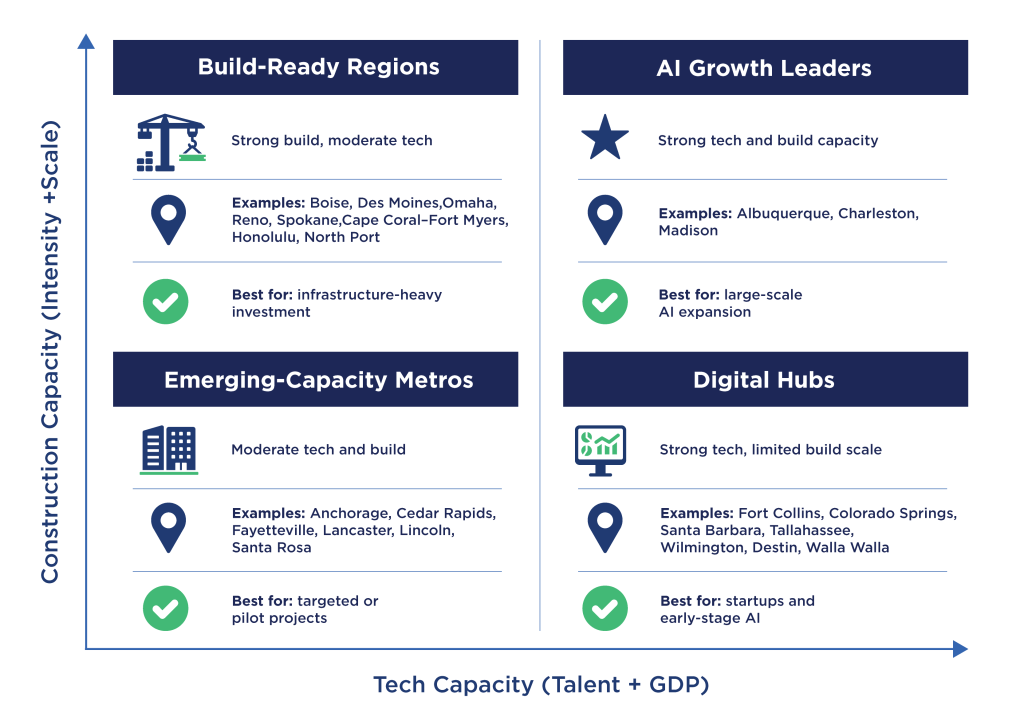
To make regional differences actionable, we group metro areas into four categories based on their combined technology and construction capacity: AI Growth Leaders, Digital Hubs, Build-Ready Regions, and Emerging-Capacity Metros (Table 1). Each reflects a distinct mix of strengths and constraints, with clear implications for both firms and local leaders. This approach prioritizes interpretation over ranking, highlighting how different combinations of digital and physical capacity shape where AI investment can realistically scale. To ensure comparability, most measures are standardized relative to the national average:
- Values above 0.5 are considered strong.
- Values between –0.5 and 0.5 are moderate.
- Values below –0.5 are weaker.
Construction scale is treated separately, as it reflects the absolute size of the workforce. Regions with 20,000 or more construction workers are considered capable of supporting multiple large projects, while smaller labor pools may face capacity constraints.
Table 1: AI Scalability Typology by Dimension Strength
Source: Kenan Institute of Private Enterprise
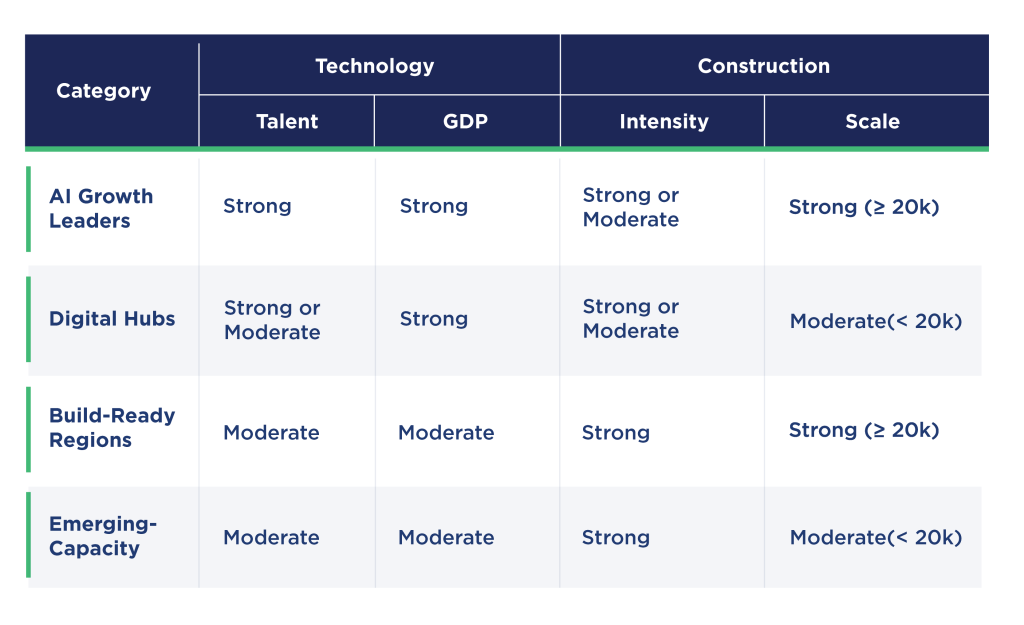
This classification provides a practical lens for aligning strategy with local conditions: Firms can match investment types to regional strengths, while local leaders can identify the capabilities needed to remain competitive. Figure 1 shows a typology matrix that groups regions based on technology and construction capacity. For an in-depth look at performance across all metros, including the 50 largest, see Table 2.
Key Findings
AI Growth Leaders combine strong tech talent and output with the construction intensity needed to scale. Examples include Albuquerque, NM; Charleston, SC; and Madison, WI (see Figure 2 for a map of all metros that fall into our designated categories). These regions are positioned to move beyond pilot activity and support large-scale AI infrastructure (see Figure 1).
Figure 1: AI Scalability Typology
Source: Kenan Institute of Private Enterprise
Even in these markets, localized constraints can shape the pace and trajectory of development. In Albuquerque and Madison, shortages of electricians and HVAC specialists — relative to surging demand — may delay buildout. In Charleston, rising labor and housing costs may increase project expenses. In these metros, developers may encounter community concern about data centers. Madison, for example, has enacted a temporary moratorium on new large data centers until environmental impacts are better understood. In the broader Albuquerque region, there is increasing awareness of potential impacts, though it has not translated into the same level of opposition seen in Madison.
Digital Hubs pair strong talent and tech output with moderate construction scale. Examples include Fort Collins, CO; Colorado Springs, CO; Santa Barbara, CA; Tallahassee, FL; Wilmington, NC; Destin, FL; and Walla Walla, WA. These regions are well suited for AI startups, research labs and early-stage deployment but may struggle to support multiple large construction projects simultaneously.
Local conditions vary, but many reflect growing demand and opportunity. In fast-growing regions like Fort Collins and Colorado Springs, infrastructure demand is rising alongside population and economic growth. These Colorado metros have also seen community concern around data center development and proactive planning measures to better understand data centers’ impacts. In Santa Barbara, higher costs may shape the scale and type of expansion, while in Destin, improving fiber connectivity could further support digital growth. In Tallahassee, grid investments are strengthening resilience to storms. In Wilmington, a proposed large-scale data center development has drawn local opposition, with residents raising concerns about environmental impacts and infrastructure strain.
Figure 2: Map of Metro Regions by Category of AI Scalability
Build-Ready Regions combine strong construction capacity with more limited tech depth. Examples include Honolulu, HI; Boise, ID; Des Moines, IA; Omaha, NE; Reno, NV; Spokane, WA; North Port, FL; and Cape Coral–Fort Myers, FL. These markets are well positioned to support the physical expansion of AI infrastructure.
Local dynamics largely reflect growth and evolving demand. Rapid expansion in Boise and Reno is tightening labor markets, particularly for skilled trades, while in Reno, increasing demand is also bringing greater attention to grid capacity and community concerns around data center development. In Cape Coral–Fort Myers, extreme weather introduces planning considerations, though continued investment in resilience can support long-term growth. Des Moines and Omaha benefit from reliable energy and connectivity, providing a strong foundation for expansion.
Emerging-Capacity Metros show moderate strength across both dimensions. Examples include Anchorage, AK; Cedar Rapids, IA; Fayetteville, NC; Lancaster, CA; Lincoln, NE; and Santa Rosa, CA. These regions are suited for incremental or specialized AI deployment but face constraints in scaling large or concurrent projects.
Local conditions in these metros often reflect emerging growth and evolving capacity. In Anchorage, higher energy and construction costs, along with geographic barriers to construction, lend themselves to more targeted, efficiency-focused development. In Cedar Rapids and Walla Walla, thinner pools of specialized trades may influence project pacing. In Santa Rosa, higher costs may guide more selective or higher-value deployment strategies. In some locations, including Fayetteville, data center proposals have prompted community discussion around the impacts of AI infrastructure.
Key Business Strategies
This typology is designed primarily for firms making decisions about AI infrastructure investment, siting, and expansion. It helps clarify which types of regions are best suited to different forms of AI activity, based on their combination of digital and construction capacity. Rather than treating markets of similar size as interchangeable, firms can use this framework to align investment strategy with local conditions. For local business and economic leaders, the typology highlights where capacity gaps may limit growth and which capabilities are most important to strengthen over time.
AI Growth Leaders combine strong digital capacity with the construction scale needed to support sustained expansion. In these regions, the central challenge is not feasibility but maintaining a competitive position as demand intensifies and costs rise. Firms operating in these markets should prioritize securing long-term access to construction and infrastructure capacity by building relationships with contractors and ensuring reliability across power, connectivity and permitting processes. As competition increases, careful attention to cost trajectories, regulatory risks and evolving community concerns around large-scale AI infrastructure becomes essential. For local leaders, the focus shifts toward managing growth pressures, particularly workforce availability, infrastructure strain, and rising costs that could limit future expansion.
Digital Hubs offer strong technical talent and innovation ecosystems but are constrained by more limited construction scale. These markets are well suited for early-stage activity such as research and pilot deployment but are less capable of supporting multiple large-scale builds simultaneously. Firms may opt to concentrate high-value, early-stage work locally while locating large-scale buildout in regions with greater construction capacity. Efforts to expand the construction workforce and specialized trades can ease constraints over time but are unlikely to fully close gaps in the near term. For local leaders, the priority is strengthening the construction workforce, particularly in critical trades such as electricians and HVAC technicians, to enable a broader range of investment.
Build-Ready Regions are characterized by strong construction capacity but more limited depth in technical talent. These markets are well positioned to support infrastructure-heavy investments, including data centers and AI-enabled logistics facilities, especially those with relatively modest staffing requirements. Firms can take advantage of these strengths by aligning project design with local labor conditions and supplementing technical roles through remote teams or targeted recruitment strategies. Over time, investments in partnerships with universities and training institutions can help deepen the local talent base. For local leaders, the opportunity lies in expanding technical capacity to capture more value from infrastructure development and attract a wider range of AI-related activity.
Emerging-Capacity Metros exhibit moderate strengths across both digital and construction dimensions but face more binding constraints that limit large-scale or concurrent development. These markets may be best suited for targeted, incremental or specialized AI projects rather than major hubs. Firms may opt to approach these regions selectively, focusing on pilot projects or a broader hub-and-spoke strategy anchored in larger nearby metros, particularly when new infrastructure development prompts community pushback. Importing specialized labor can help fill gaps, though it may increase costs and complexity. For local leaders, the priority is building foundational capacity in both talent and infrastructure to improve long-term competitiveness and enable more scalable growth.
Brief Overview of Methodology
This analysis focuses on U.S. metro areas — economically interconnected regions that share labor markets, infrastructure and supply chains. The study examines the 150 largest metro areas, with deeper analysis concentrated on a subset of 100 midsize markets.
To compare markets in a practical way, we evaluate four factors that shape where AI infrastructure can scale. Together, these factors capture both digital and construction capacity:
- Tech talent: The share of the workforce with a bachelor’s or higher in high tech (e.g., software, data and engineering) determines whether firms can deploy and operate AI systems locally.
- Tech GDP: The size and strength of the local technology sector signals whether a region already supports advanced digital activity.
- Construction intensity: The concentration of construction activity (i.e., construction employment per 1,000 residents), where high per‑capita construction employment indicates a well-developed and readily deployable construction workforce.
- Construction scale: The total size of the construction workforce determines whether a region can support multiple large projects at once. This is particularly important for AI infrastructure, where data centers and related facilities require large, coordinated buildouts over relatively short timeframes.
In addition to these four factors, a range of local conditions can influence AI infrastructure construction. These include the availability of specialized trades (such as electricians), the reliability of power and broadband, local costs, local opposition to data center construction, and exposure to risks such as extreme weather. While not directly part of the classification, we examined these factors to help explain why similar regions may face different execution challenges.
Conclusion
This report highlights the place-based constraints shaping AI expansion, providing a tool for understanding which areas are best suited to specific kinds of AI development. While much of the existing literature focuses on where AI activity is currently concentrated, our analysis shows that the next phase of growth will depend on a region’s capacity to scale physical infrastructure. By incorporating construction intensity and scale into our framework, we identify a broad set of midsize markets that are well positioned to support the next wave of AI expansion.
These opportunities for growth come with localized considerations. Place-based factors — including labor availability, local pushback against data centers, and cost pressures — influence the pace and feasibility of growth across regions. However, most of the metro areas identified in this report have the foundational conditions needed to support AI-driven development, particularly when business and policy strategies are aligned to take advantage of an area’s strengths and overcome its challenges. This report’s findings suggest that the midsize regions in the U.S. will play a key role in the next wave of AI infrastructure expansion.
Written by: Sarah Dickerson, Research Economist, Kenan Institute of Private Enterprise
KEY TAKEAWAYS
- Technical talent remains critical to artificial intelligence expansion, but regions that have the ability to build — data centers, labs and infrastructure — are best positioned to capture the next wave of AI investment.
- Midsize metros are emerging as viable AI locations. San Francisco still leads among tech hubs, but a growing set of midsize metros offer tech talent, affordability and build capacity.
- By segmenting regions into four groups — AI Growth Leaders, Digital Hubs, Build-Ready Regions and Emerging-Capacity Metros — this report shows that firms and policymakers must align AI growth strategies with local conditions rather than rely on one-size-fits-all approaches.